September 20, 2026
Review of Sewer Repair Options for LA Homes
A review of sewer repair options for Los Angeles homes, including spot repairs, trenchless methods, replacement costs, and how to compare licensed plumbers.
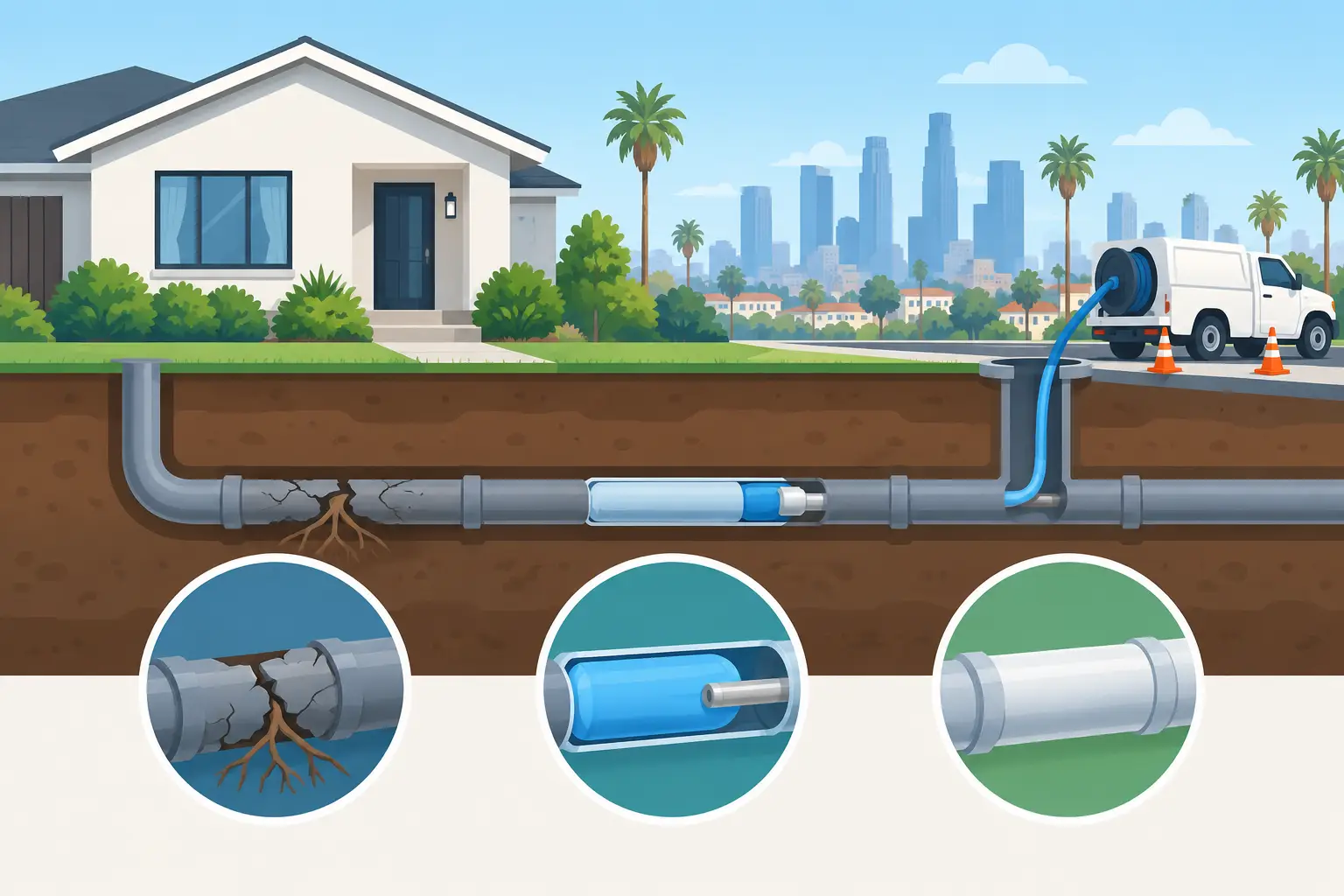
A sewer backup is not the time to accept the first vague diagnosis or lowest verbal quote. For Los Angeles homeowners and property managers, a review of sewer repair options should begin with one question: what does the camera inspection actually show? The right repair depends on the pipe material, damage location, access, root activity, and whether the line has failed in one area or along its full length.
A qualified, licensed plumber should be able to explain the findings in plain language, show relevant camera footage or still images, and put the recommended scope in writing. That makes it easier to compare real repair options, not just competing price tags.
Start With a Sewer Camera Inspection
Slow drains, recurring clogs, sewage odors, wet patches, and backups from more than one fixture can all point to a main sewer line problem. They can also have other causes. A sewer camera inspection helps separate a localized blockage from cracked pipe, root intrusion, a shifted joint, corrosion, or a collapsed section.
The inspection should identify the approximate distance to the problem, the pipe diameter and material when visible, and whether the line holds its grade. In older Los Angeles County properties, cast iron, clay, Orangeburg, and aging galvanized connections may be part of the picture. Each material fails differently, and no repair method is automatically best for all of them.
Ask whether the plumber can locate the defect from the surface and whether cleaning is needed before the camera can provide a clear view. If a company recommends full replacement without documenting the line condition, get a second opinion before authorizing work.
Review of Sewer Repair Options: What Each Method Solves
Drain cleaning and root removal
For a line that is structurally sound but obstructed by roots, grease, scale, or debris, cable cleaning or hydro jetting may restore flow. This is maintenance or a short-term correction, not a structural repair. Roots often return through cracked joints or separated pipe sections, particularly in neighborhoods with mature landscaping.
Cleaning is a sensible first step when the camera shows no major breaks, bellies, or collapse. It is not a dependable answer if the pipe is repeatedly backing up or the footage shows roots entering through multiple damaged joints.
Localized spot repair
A spot repair replaces or repairs one damaged section of pipe. It is often appropriate for a single crack, isolated root-damaged joint, or small collapsed area when the remainder of the sewer line is in good condition.
Traditional spot repair usually requires excavation. That may mean opening a section of yard, driveway, slab, or landscaping. The benefit is direct access and the ability to replace the failed piece with new pipe. The trade-off is restoration work after the plumbing repair, which should be included or clearly excluded in the estimate.
For a property with a relatively new line and one confirmed defect, a spot repair can be more cost-effective than replacing the entire run. For an older clay or cast-iron system with several weak areas, it can become a repeating expense.
Trenchless pipe lining
Cured-in-place pipe lining creates a new pipe-like interior within the existing host pipe. A resin-saturated liner is inserted, positioned, and cured to seal cracks, joints, and certain root-entry points. It is commonly considered when the existing line has enough structural continuity to support the liner and access points are available.
The major advantage is reduced digging. Lining can avoid removing sections of concrete, hardscape, or landscaping, which matters on densely built Los Angeles properties. It may also be useful beneath patios or areas where excavation would be disruptive.
Lining is not a cure for every sewer problem. A fully collapsed line, severe offset, major belly, or pipe with little remaining internal diameter may not be a good candidate. The process slightly reduces the pipe's interior diameter, although a properly designed lining job can still provide strong flow. Ask the contractor to explain why the line qualifies for lining and whether post-installation camera footage is included.
Pipe bursting
Pipe bursting replaces an existing line by pulling a new pipe through the old pipe's path while breaking apart the failing line. Like lining, it can limit open trenching, but it requires appropriate access at both ends and suitable site conditions.
This method can be a strong option when a full replacement is needed but minimizing surface disruption is a priority. It may be less suitable near sensitive utilities, unusual pipe routes, or areas with limited equipment access. A contractor should confirm utility locations and explain how transitions to the house connection and city lateral are handled.
Conventional excavation and replacement
Open-trench replacement is the most direct option. The plumber excavates to expose the sewer line, removes damaged pipe, and installs new material. It can address severe collapse, incorrect slope, extensive deterioration, and conditions that trenchless methods cannot reliably correct.
It is often the right long-term answer for a line that has failed across multiple sections or has a persistent belly that holds waste and water. The downside is disruption. Excavation may affect landscaping, walkways, driveways, flooring, or slabs depending on the pipe route.
Do not assume conventional replacement is outdated or automatically more expensive. On an accessible side yard, it may be the clearest and most economical permanent repair. Under a decorative driveway or finished interior, the restoration costs can change that calculation.
Cost Depends on Access, Scope, and Restoration
Sewer repair pricing varies widely because the plumbing work is only part of the job. Camera inspection, locating, permits, excavation depth, soil conditions, traffic control, pipe length, cleanout installation, and restoration can all affect the final price.
A simple cleaning may cost far less than a repair, while a localized excavation or trenchless repair can range into several thousand dollars. Full sewer replacement can be substantially higher, especially when work crosses concrete, a public right-of-way, or an occupied multi-unit property. Treat any price range as a starting point, not a diagnosis.
A useful written estimate separates the work into clear categories: inspection and locating, repair method, pipe length and material, permits, access points, backfill, testing, and restoration. If restoration is excluded, ask exactly what surfaces will be left open and who is responsible for returning them to their prior condition.
Compare Plumbers on Proof, Not Promises
Sewer work is high-stakes because the wrong repair can leave a property with repeated backups, damaged finishes, and another major bill. Before choosing a contractor, verify an active California plumbing license and make sure the license classification and business name match the proposal. For larger jobs, confirm insurance and ask whether permits and inspections are included.
Real review patterns are more useful than a perfect rating alone. Look for recent reviews that mention sewer cameras, trenchless work, clean job sites, communication, and how the company handled unexpected findings. Review volume, years in business, emergency availability, and sewer-specific experience are practical comparison points.
Ask each plumber the same questions: What did the camera show? Is this a one-section failure or a system-wide issue? Why is this repair method appropriate? What could change the price? What warranty applies to labor and materials? A contractor who answers directly gives you a clearer basis for a decision.
For Los Angeles County properties, also ask whether the problem may involve the private lateral, the connection near the property line, or a public sewer issue. Responsibility can vary by location and condition, so a plumber should document where the defect appears rather than making assumptions.
When a Fast Decision Is Necessary
If sewage is backing up into tubs, showers, toilets, or floor drains, stop using water fixtures as much as possible and contact a licensed emergency plumber. Avoid running laundry, dishwashers, or additional toilets until the line is evaluated. If wastewater has entered living areas, professional cleanup may also be needed.
For non-emergency symptoms, take the time to compare at least two documented recommendations when the repair is extensive. The Plumbing Connection helps Los Angeles residents compare licensed local plumbers by specialty, service area, review signals, and availability, without a lead broker standing between you and the provider.
The best sewer repair is the one that matches verified pipe conditions, protects the property from repeat failure, and comes with a scope you can understand before work begins.
Get a free quote from a local plumber
Tell us what you need. Vetted plumbers in your area will reach out, usually the same day. No cost, no obligation.
Related Articles
Is Trenchless Sewer Worth It for LA Homes?
Is trenchless sewer worth it? Compare costs, limits, and long-term value for Los Angeles homes before choosing a licensed local plumber with confidence.
Best Plumbers for Apartment Buildings in LA
Find the best plumbers for apartment buildings in Los Angeles County. Compare verified licenses, real reviews, specialties, and emergency availability.
Emergency Plumber Response Time Example Explained
See an emergency plumber response time example for Los Angeles, learn what affects arrival, and choose a licensed pro without delays or surprises.
Need a Plumber in Los Angeles?
Compare 112+ verified plumbers with real reviews from Google and Yelp.
Find a Plumber Near You